Artificial Intelligence (AI) is no longer a futuristic concept. It is already changing how businesses operate, serve customers, make decisions, and compete in the market. From small startups to large global corporations, organizations are investing heavily in AI technologies to improve efficiency, reduce costs, and create better customer experiences.
One question that business owners, managers, and professionals frequently ask is: “how will ai affect business in the future?”
The answer is both exciting and complex. AI will not simply automate repetitive tasks. It will reshape entire industries, redefine jobs, transform customer relationships, and create new opportunities that were impossible just a few years ago.
Businesses that understand these changes and adapt early will likely gain significant advantages. Those that ignore AI may struggle to compete in an increasingly digital economy.
This comprehensive guide explores how will ai affect business in the future, the opportunities it creates, the challenges organizations may face, and what companies should do now to prepare for the AI-driven world ahead.
Understanding Artificial Intelligence in Business
Artificial Intelligence refers to computer systems that can perform tasks typically requiring human intelligence. These tasks include:
- Learning from data
- Recognizing patterns
- Understanding language
- Making predictions
- Solving problems
- Generating content
- Supporting decision-making
Modern AI systems can analyze enormous amounts of information within seconds, helping businesses make faster and smarter decisions.
Examples of AI in business today include:
- Customer service chatbots
- Virtual assistants
- Recommendation engines
- Fraud detection systems
- Predictive analytics
- Automated marketing tools
- AI-powered content creation
- Smart inventory management
While these applications are already valuable, future AI capabilities will be far more advanced.
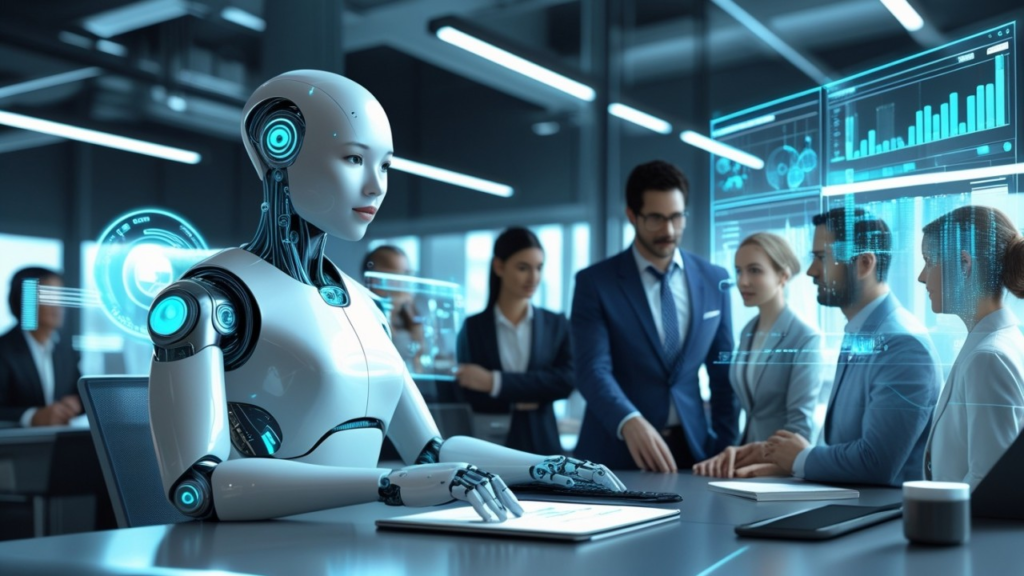
Why AI Is Becoming Essential for Businesses
The business world is becoming increasingly competitive. Companies must serve customers faster, operate more efficiently, and innovate continuously.
AI helps organizations achieve these goals by:
- Reducing manual work
- Improving accuracy
- Increasing productivity
- Lowering operational costs
- Enhancing customer experiences
- Generating business insights
As technology advances, AI will become as important to businesses as the internet is today.
Companies that adopt AI strategically will likely outperform competitors in speed, innovation, and profitability.
How Will AI Affect Business in the Future? The Big Picture
The future impact of AI will extend far beyond automation.
AI will become a core business partner rather than just a software tool.
Instead of merely completing tasks, future AI systems will:
- Assist with strategic planning
- Support executive decisions
- Predict market trends
- Identify new business opportunities
- Personalize customer experiences
- Enhance workforce productivity
Businesses will increasingly rely on AI to make informed decisions in real time.
The result will be faster, smarter, and more adaptive organizations.
AI Will Transform Decision-Making
One of the most significant ways AI will affect business in the future is through improved decision-making.
Traditional business decisions often rely on:
- Historical reports
- Human intuition
- Limited datasets
AI changes this process by analyzing millions of data points simultaneously.
Also Read: How to Use AI to Grow Photography Business: The Ultimate Guide for Photographers in 2026
Future AI systems will help leaders answer questions such as:
- Which products should we launch next?
- Which customers are likely to leave?
- Where should we invest resources?
- What market trends are emerging?
- Which risks should we prepare for?
Rather than replacing executives, AI will serve as an intelligent advisor.
This combination of human judgment and machine intelligence may lead to better business outcomes.
Customer Experiences Will Become Hyper-Personalized
Customers increasingly expect personalized experiences.
AI will make personalization more powerful than ever.
Future AI systems will analyze:
- Purchase history
- Browsing behavior
- Preferences
- Demographics
- Customer feedback
- Real-time interactions
Based on this information, businesses can deliver:
- Personalized recommendations
- Customized marketing messages
- Tailored product offerings
- Individualized pricing strategies
- Unique customer experiences
Instead of treating customers as groups, companies will engage with individuals.
This shift could significantly improve customer satisfaction and loyalty.
AI-Powered Customer Service Will Become the Standard
Customer service is already being transformed by AI chatbots and virtual assistants.
In the future, these systems will become much more sophisticated.
Advanced AI customer service solutions will:
- Understand complex questions
- Detect emotions
- Respond naturally
- Resolve issues independently
- Operate 24/7
- Support multiple languages
Customers may receive instant support without waiting for human agents.
Human representatives will focus on more complicated situations requiring empathy and critical thinking.
This balance between AI and human support could create better customer experiences while reducing operational costs.
Business Operations Will Become More Efficient
Efficiency is one of AI’s greatest strengths.
Future businesses will use AI to optimize nearly every operational process.
Examples include:
Inventory Management
AI can predict demand more accurately, reducing shortages and excess inventory.
Supply Chain Optimization
AI can identify disruptions before they occur and suggest alternative solutions.
Resource Allocation
Companies can allocate staff, budgets, and equipment more effectively.
Process Automation
Routine administrative tasks can be completed automatically.
The result will be leaner operations, lower costs, and improved productivity.
AI Will Revolutionize Marketing
Marketing is already experiencing significant AI-driven changes.
Future AI marketing systems will:
- Create content automatically
- Analyze consumer behavior
- Predict buying patterns
- Optimize advertising campaigns
- Improve audience targeting
- Generate personalized messaging
Businesses will be able to reach the right customer with the right message at the right time.
Marketing budgets may become more efficient because AI can continuously improve campaign performance.
Companies that leverage AI marketing tools effectively may achieve higher returns on investment.
Sales Teams Will Become More Productive
AI will not replace sales professionals entirely.
Instead, it will help them work smarter.
Future AI tools will:
- Identify high-quality leads
- Predict customer needs
- Recommend sales strategies
- Automate follow-ups
- Analyze customer interactions
Sales teams will spend less time on administrative work and more time building relationships.
This could lead to higher conversion rates and increased revenue.
AI Will Create New Business Models
Perhaps one of the most overlooked aspects of AI is its ability to create entirely new business models.
Throughout history, major technological advancements have generated new industries.
AI is likely to do the same.
Future businesses may offer:
- AI consulting services
- AI-generated products
- AI-powered subscription platforms
- Autonomous business solutions
- Intelligent digital assistants
Entrepreneurs who identify emerging opportunities early may build highly successful companies.
The future economy may include industries that do not currently exist.
The Workplace Will Change Dramatically
Many people worry that AI will eliminate jobs.
While some roles may disappear, many new opportunities will emerge.
History shows that technological innovation often transforms jobs rather than eliminating work entirely.
Future employees may work alongside AI systems every day.
Workers will increasingly focus on:
- Creativity
- Strategy
- Innovation
- Relationship building
- Leadership
- Complex problem-solving
Meanwhile, AI will handle repetitive and data-intensive tasks.
Organizations that invest in employee training and reskilling will likely adapt more successfully.
Remote Work Will Become More Advanced
AI will improve remote and hybrid work environments.
Future AI tools may:
- Schedule meetings automatically
- Summarize discussions
- Manage workflows
- Track project progress
- Improve team collaboration
Employees will have access to intelligent assistants that help them stay productive regardless of location.
This could make remote work more efficient and sustainable for businesses worldwide.
AI Will Strengthen Cybersecurity
Cybersecurity threats continue to grow.
AI will play a crucial role in protecting businesses.
Future AI security systems may:
- Detect threats instantly
- Identify unusual behavior
- Prevent cyberattacks
- Monitor networks continuously
- Respond automatically to security incidents
Because cybercriminals are also using AI, businesses must adopt advanced security technologies to stay protected.
AI-powered cybersecurity may become a necessity rather than a luxury.
Financial Management Will Become Smarter
Financial departments will benefit significantly from AI.
Future AI systems may:
- Forecast revenue
- Predict cash flow issues
- Detect fraud
- Analyze investments
- Optimize budgets
Business leaders will gain deeper financial insights and make more informed decisions.
Small businesses may gain access to sophisticated financial tools previously available only to large corporations.
Healthcare Businesses Will Experience Major AI Growth
Healthcare is one of the industries most likely to benefit from AI.
Healthcare organizations may use AI for:
- Diagnostic support
- Patient monitoring
- Medical imaging analysis
- Administrative automation
- Personalized treatment recommendations
These advancements could improve patient outcomes while reducing costs.
Healthcare businesses that adopt AI responsibly may gain competitive advantages and improve service quality.
Manufacturing Will Become More Intelligent
Smart factories are already emerging.
Future manufacturing businesses may use AI to:
- Predict equipment failures
- Improve product quality
- Optimize production schedules
- Reduce waste
- Increase efficiency
AI-powered manufacturing systems can operate with greater precision and consistency than traditional methods.
This may lead to lower costs and higher-quality products.
Retail Businesses Will Become More Customer-Centric
Retail companies are expected to use AI extensively.
Future retail applications include:
- Personalized shopping experiences
- Smart pricing systems
- Demand forecasting
- Inventory optimization
- Virtual shopping assistants
Customers may enjoy more convenient, customized, and engaging shopping experiences.
Retailers that effectively use AI could build stronger customer relationships and increase sales.
Small Businesses Will Benefit from AI
A common misconception is that AI only helps large corporations.
In reality, AI may level the playing field.
Affordable AI tools allow small businesses to:
- Automate tasks
- Improve marketing
- Analyze customer behavior
- Enhance customer service
- Compete more effectively
Future AI platforms will likely become even more accessible.
Small businesses that embrace AI early may gain significant competitive advantages.
The Rise of Predictive Business Intelligence
Predictive intelligence may become one of AI’s most valuable contributions.
Instead of analyzing past performance, AI will increasingly predict future outcomes.
Businesses may forecast:
- Market demand
- Customer behavior
- Economic trends
- Industry disruptions
- Competitive threats
This proactive approach allows organizations to prepare for opportunities and challenges before they occur.
Ethical AI Will Become a Business Priority
As AI adoption grows, ethical concerns will become increasingly important.
Businesses must address issues such as:
- Data privacy
- Algorithmic bias
- Transparency
- Accountability
- Security
Consumers are becoming more aware of how companies use data.
Organizations that use AI responsibly may earn greater trust and stronger customer loyalty.
Ethical AI practices will likely become a competitive advantage.
AI and Human Collaboration Will Define Success
One of the biggest misconceptions about AI is that machines will replace humans entirely.
The future is more likely to involve collaboration.
The most successful organizations will combine:
- Human creativity
- Human empathy
- Human judgment
With:
- AI speed
- AI analysis
- AI automation
This partnership can unlock levels of productivity and innovation that neither humans nor machines could achieve alone.
Challenges Businesses Must Prepare For
While AI offers enormous opportunities, it also presents challenges.
Workforce Adaptation
Employees will need new skills to work effectively with AI systems.
Data Quality
Poor data can lead to inaccurate AI predictions.
Privacy Concerns
Businesses must protect customer information responsibly.
Implementation Costs
AI investments can require significant resources.
Regulatory Compliance
Governments may introduce new AI regulations.
Organizations that proactively address these challenges will be better positioned for long-term success.
Industries Most Likely to Be Transformed by AI
Several industries are expected to experience major AI-driven transformation.
These include:
- Healthcare
- Finance
- Retail
- Manufacturing
- Transportation
- Logistics
- Education
- Real Estate
- Marketing
- Entertainment
However, nearly every industry will feel AI’s influence in some way.
The question is no longer whether AI will affect businesses, but how quickly those changes will occur.
What Businesses Should Do Today
Companies preparing for the future should consider several key actions.
Invest in AI Education
Leaders and employees should understand AI fundamentals.
Start Small
Pilot projects can help organizations gain experience.
Focus on Data Quality
Accurate data improves AI performance.
Develop Ethical Guidelines
Responsible AI use builds trust.
Encourage Innovation
Employees should be empowered to explore AI opportunities.
Monitor Industry Trends
AI technology evolves rapidly.
Businesses that remain informed can adapt more effectively.
Future Predictions: What Business May Look Like by 2035
By 2035, many experts expect AI to become deeply integrated into daily business operations.
Potential developments include:
- AI-powered digital employees
- Fully automated customer support
- Real-time predictive decision-making
- Autonomous supply chains
- Personalized business ecosystems
- Advanced virtual work environments
Organizations may become more agile, efficient, and data-driven than ever before.
Also Raed:How Many Businesses Use AI ? Statistics, Trends, Benefits, and Future Outlook
The businesses that thrive will likely be those that view AI as a strategic partner rather than simply another technology tool.
Conclusion
The question “how will ai affect business in the future” is one of the most important questions facing modern organizations.
AI is poised to transform nearly every aspect of business, including operations, marketing, sales, customer service, cybersecurity, finance, and strategic decision-making.
The future will not belong solely to businesses with the most advanced technology. Instead, it will belong to organizations that successfully combine human talent with artificial intelligence.
Companies that embrace AI thoughtfully, invest in employee development, prioritize ethical practices, and remain adaptable will be best positioned for long-term success.
Rather than fearing AI, businesses should view it as an opportunity to innovate, grow, and create greater value for customers. The organizations that start preparing today will be better equipped to lead tomorrow’s AI-driven economy.
Frequently Asked Questions (FAQs)
Will AI completely replace human workers in the future?
No. AI is more likely to automate specific tasks rather than replace entire professions. Human creativity, emotional intelligence, leadership, and strategic thinking will remain valuable.
Can small businesses compete with large companies using AI?
Yes. Affordable AI tools are making advanced technologies accessible to businesses of all sizes, helping smaller companies compete more effectively.
Which business department will benefit most from AI?
Customer service, marketing, operations, finance, and sales are all expected to benefit significantly. The greatest impact depends on the company’s goals and industry.
How long will it take for AI to transform most businesses?
Many businesses are already experiencing AI-driven changes. Significant transformation is expected throughout the next decade as AI technologies become more advanced and widely adopted.
Will AI reduce business costs?
In many cases, yes. AI can automate repetitive tasks, improve efficiency, reduce errors, and optimize resource allocation, leading to cost savings.
What skills should future business professionals develop because of AI?
Critical thinking, communication, leadership, creativity, emotional intelligence, problem-solving, and AI literacy will become increasingly valuable.
Can AI help businesses become more environmentally friendly?
Yes. AI can optimize energy use, reduce waste, improve logistics, and help companies achieve sustainability goals.
Will customers know when they are interacting with AI?
Future regulations and ethical standards may require businesses to disclose AI interactions. Transparency is likely to become increasingly important.
How can startups use AI to grow faster?
Startups can use AI for market research, customer support, content creation, predictive analytics, lead generation, and operational automation to accelerate growth.
What is the biggest opportunity AI creates for businesses?
The biggest opportunity is the ability to make smarter decisions faster while delivering highly personalized customer experiences at scale. This combination can drive innovation, growth, and long-term competitive advantage.