The term quad equalizer can sound confusing because it is used in more than one technical context. In audio, a quad equalizer generally refers to an equalization system that works with four channels, four sections, or four adjustable frequency-processing paths. Depending on the equipment, it may be used to shape bass, midrange, treble, or more specific frequency bands.
The basic purpose is simple: an equalizer changes the level of selected frequencies so that audio sounds more balanced, clear, controlled, or suited to a particular listening environment.
A quad equalizer can appear in professional sound systems, recording studios, live sound setups, synthesizer systems, digital audio equipment, and software. Some products use “quad” because they provide four independent equalizer channels. Others use the word in a different way, such as a quad DAC in a smartphone.
This distinction is important. A quad equalizer is not automatically the same thing as a quad DAC, quad-core processor, four-channel amplifier, or a mathematical expression involving the number four.
For example, the LG V20 became well known for its 32-bit Hi-Fi Quad DAC. That technology was designed for digital-to-analog conversion and high-quality headphone output, not simply for equalizing four audio bands. LG described the V20 as using an ESS-based Quad DAC with features such as fine volume and left/right balance control.
This guide explains what quad equalizer means, how it works, why people use it, how it differs from related technologies, and how to interpret the many different searches that include the word “quad.”
What Is a Quad Equalizer?
A quad equalizer is an audio equalization device or system designed around four channels, four sections, or four controllable equalization paths.
An equalizer, commonly called an EQ, allows a listener or sound engineer to increase or decrease selected frequency ranges. For example, an EQ can reduce excessive bass, improve vocal clarity, soften harsh high frequencies, or correct problems caused by a room.
The word “quad” normally means four. Therefore, the simplest interpretation of quad equalizer is an equalizer involving four audio paths or four EQ sections.
However, the exact design depends on the product.
A four-channel digital graphic equalizer may allow four separate audio channels to be processed. A modular synthesizer module may provide four independent voltage-controlled filters. A software plugin might offer four EQ modules inside one processing unit.
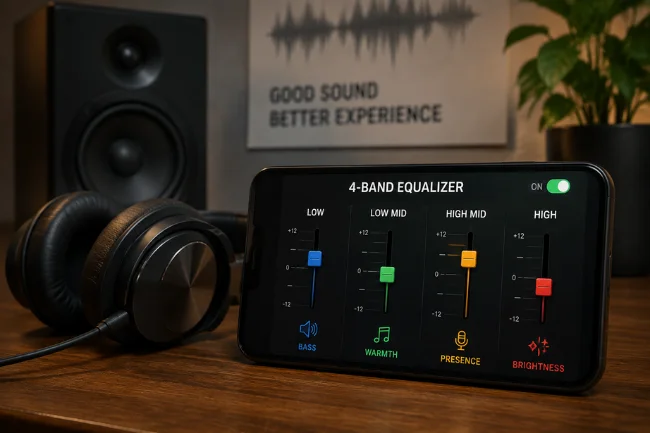
This means there is no single universal technical specification for every device called a quad equalizer.
What Does an Equalizer Do?
To understand a quad equalizer, it helps to understand frequency.
Sound contains different frequencies. Human hearing generally covers a broad range from low frequencies to high frequencies, although the exact range varies from person to person.
Low frequencies are often associated with bass.
Middle frequencies contain much of the information that makes speech, vocals, guitars, keyboards, and many other instruments recognizable.
High frequencies are associated with treble, detail, brightness, and air.
An equalizer changes the relative level of these frequencies.
For example:
A bass-heavy recording may benefit from reducing some low-frequency energy.
A dull vocal may benefit from a carefully chosen increase in the upper-midrange.
A harsh recording may sound smoother after reducing certain high frequencies.
A live sound system may need EQ adjustments to control feedback or compensate for room acoustics.
The important point is that an equalizer does not create missing musical information in the same way a new recording would. It mainly changes the balance of frequency components that are already present.
Also Read: Jipinfeiche: A Complete Guide
Why Is It Called “Quad”?
Quad means four.
In audio equipment, the word may describe four channels or four processing sections. This is different from saying that the equalizer only has four frequency controls.
For example, a four-channel digital graphic equalizer can contain many adjustable frequency filters for each of its four channels.
A historical Mackie Quad EQ is a useful example. Its documentation describes it as a 4-channel digital graphic equalizer. The manual also describes 30 Adaptive-Q filters across the audio frequency range, showing why “quad” should not automatically be interpreted as “four frequency bands.”
This is an important distinction for beginners.
Quad can describe the number of channels while the EQ itself may contain many frequency bands.
Quad Equalizer vs Four-Band Equalizer
These terms are sometimes confused.
A four-band equalizer has four adjustable frequency bands.
A quad equalizer may have four channels, with each channel containing several EQ bands.
These are not necessarily the same design.
Imagine a system with four audio channels. Each channel has multiple frequency controls. That is a quad-channel EQ system.
By contrast, a simple four-band EQ might operate on one stereo signal but provide only four frequency areas to adjust.
Therefore, always check the product’s specifications instead of assuming that “quad” means four frequency bands.
How a Quad Equalizer Works
A quad equalizer receives an audio signal and separates or processes frequency information according to its design.
The signal can then be adjusted at selected frequencies.
The basic process is:
Audio enters the EQ.
The EQ identifies or processes selected frequency ranges.
The user applies boosts or cuts.
The processed audio leaves the EQ.
A boost increases the level around a selected frequency.
A cut reduces the level around a selected frequency.
The amount of change is commonly measured in decibels, or dB.
For example, a +3 dB adjustment means a frequency area has been boosted. A -3 dB adjustment means it has been reduced.
The effect depends on the center frequency, bandwidth, filter type, and amount of gain.
Understanding Frequency in Simple Terms
Frequency is measured in hertz, or Hz.
Low frequencies may include deep bass.
Midrange frequencies cover a large portion of musical and speech information.
High frequencies contain many of the details associated with brightness and clarity.
A basic example might look like this:
60 Hz: deep bass
120 Hz: bass
250 Hz: lower midrange
500 Hz: midrange
1 kHz: central midrange
2 kHz: upper midrange
4 kHz: presence and clarity
8 kHz: treble
16 kHz: high-frequency detail
These are only general examples. The best EQ setting depends on the recording, speakers, headphones, room, and listener.
Types of Quad Equalizers
Not every quad equalizer is built the same way.
Quad Graphic Equalizer
A graphic equalizer normally provides a collection of fixed frequency bands. Each band can be boosted or cut.
A quad graphic equalizer can provide this type of control across four channels.
The Mackie Quad EQ is an example of a product associated with this category. Its documentation identifies it as a four-channel digital graphic equalizer and describes Adaptive-Q filters, real-time analysis, filters, and measurement microphone functionality.
Graphic EQs can be useful when a user wants to see and adjust several frequency points quickly.
Also Read: Axurbain: Its Meaning, Uses, Benefits, and Digital Importance
Quad Parametric Equalizer
A parametric EQ provides more detailed control.
Instead of simply moving fixed sliders, a parametric EQ may let the user control:
Frequency
Gain
Bandwidth or Q
This makes parametric EQ useful for precise corrective work.
Quad Resonant Equalizer
A resonant equalizer can emphasize certain frequencies around a filter’s center frequency.
The L-1 Quad VC Resonant Equalizer is an example of a specialized modular audio device. It is described as a four-channel parametric EQ with voltage control over its parameters. Its channels can also operate as independent filters, with different filter configurations available.
This is particularly relevant to modular synthesizer users.
Digital Quad Equalizer
A digital quad EQ processes audio using digital signal processing.
Digital systems can provide features that would be difficult or expensive to implement with traditional analog circuitry.
Examples include:
Presets
Real-time analysis
Automated measurement
Recallable settings
Multiple filter types
Digital displays
Software control
Some older professional digital EQs remain interesting because they introduced advanced features that are still common in modern software.
What Is the Mackie Quad EQ?
The phrase Mackie quad equalizer generally refers to the Mackie Quad EQ, a four-channel digital graphic equalizer.
The product documentation describes it as a 4-channel digital graphic equalizer. It includes multiple filters across the audio frequency range rather than only four frequency bands. It also includes functions such as real-time analysis and measurement microphone input.
The Mackie Quad EQ is therefore a good example of why the phrase quad equalizer can mean a four-channel EQ system rather than a four-band EQ.
Because this is older equipment, availability, support, condition, and replacement parts can vary in today’s used market.
If you are evaluating one, it is sensible to check the actual condition of the unit, display, controls, inputs, outputs, power supply, and documentation rather than relying only on its historical specifications.
What Is the L-1 Quad VC Resonant Equalizer?
The L-1 Quad VC Resonant Equalizer is associated with modular synthesis and voltage-controlled audio processing.
The “Quad” part refers to its four-channel architecture.
The device can operate as a quad EQ or as four independent filters. It also provides voltage control over parameters, making it useful in modular synthesis environments where audio processing can change dynamically according to control voltages.
This is different from a typical consumer stereo equalizer.
A modular synthesizer user may use such a device not only to correct sound but also to create movement, resonance, filtering effects, and evolving timbres.
Quad Equalizer in Music Production
A quad equalizer can be useful in music production when multiple signals need separate treatment.
For example, a producer might have four independent sources:
Vocal
Bass
Guitar
Keyboard
Each source could require a different EQ strategy.
The vocal might need clarity.
The bass might need control in the low frequencies.
The guitar might need less low-end buildup.
The keyboard might need space for other instruments.
Using separate channels makes it possible to process each source independently.
This is one of the strongest reasons to use a multi-channel EQ.
Quad Equalizer for Live Sound
Live sound environments can create difficult frequency problems.
A room may make some frequencies sound louder than others.
A microphone may create feedback at particular frequencies.
A speaker system may require tonal adjustment.
A four-channel EQ can help a sound engineer manage several signals or speaker paths.
For example, a system might use different EQ processing for:
Main left speaker
Main right speaker
Monitor system
Additional speaker or subwoofer path
The exact setup depends on the sound system.
Quad Equalizer and Feedback Control
Feedback happens when a microphone picks up sound from a speaker, which is amplified and returned to the speaker again.
This loop can create an increasingly loud tone.
Equalization can sometimes help reduce feedback by lowering the frequency where the problem occurs.
However, EQ should not be treated as the only solution.
Good microphone placement, speaker positioning, gain management, room design, and appropriate equipment are also important.
Excessive EQ cuts can damage the overall sound quality.
What Is Q in an Equalizer?
The word “Q” has a special meaning in EQ.
Q describes the relative width of a filter’s affected frequency range.
A higher Q usually means a narrower adjustment.
A lower Q usually means a wider adjustment.
For example, a narrow EQ cut can be useful for reducing a specific unwanted resonance.
A wide adjustment may be more appropriate when making a broad tonal change.
This is why parametric equalizers are powerful.
They allow the user to choose not only how much a frequency is changed but also how wide the change is.
Quad Equalizer Settings for Beginners
There is no universal perfect EQ setting.
A good starting point is to make small changes.
If the sound has too much bass, try a small reduction in the low-frequency area.
If vocals are difficult to understand, listen for the midrange rather than immediately boosting treble.
If the sound is too harsh, consider whether upper-mid or high-frequency energy is excessive.
If the recording sounds dull, a small high-frequency adjustment may help.
Avoid making large changes without listening carefully.
The goal is usually balance, not maximum bass or maximum treble.
Why More EQ Is Not Always Better
A common beginner mistake is to think that more EQ produces better sound.
It does not.
Large boosts can create distortion, reduce headroom, or make a mix sound unnatural.
Large cuts can remove important musical information.
EQ should normally solve a problem or support a creative goal.
A useful rule is to ask:
What problem am I trying to solve?
If there is no clear answer, the adjustment may not be necessary.
Quad Equalizer and Headphones
Headphones can have their own frequency characteristics.
One headphone model may sound bass-heavy.
Another may sound bright.
Another may have a strong midrange.
EQ can help users adjust the sound according to personal preference.
However, a quad equalizer does not automatically mean better headphone quality.
The quality of the headphones, amplifier, DAC, recording, source material, and EQ implementation all matter.
Quad DAC vs Quad Equalizer
This is one of the most important distinctions.
A DAC is a digital-to-analog converter.
An equalizer changes frequency balance.
They perform different jobs.
The LG V20 is a famous example of the term “Quad DAC.” LG announced that the V20 included a 32-bit Hi-Fi Quad DAC developed with ESS Technology. LG said the system was intended to improve wired headphone audio quality and reduce unwanted noise.
A Quad DAC should therefore not be described as a quad equalizer.
A device can have a high-quality DAC and an equalizer at the same time, but they remain separate functions.
LG V20 Quad DAC Equalizer
Searches for LG V20 quad DAC equalizer often combine two different ideas.
The first is the Quad DAC hardware.
The second is equalization or sound customization.
The LG V20 was notable because it combined high-quality audio hardware with audio controls. LG’s own material describes 75-stage fine volume control and left/right balance control, along with support for several lossless formats.
The important lesson is that Quad DAC and EQ should not be treated as synonyms.
A DAC converts digital audio into an analog signal.
An EQ changes the tonal balance.
LG V30 Quad DAC Equalizer
The LG V30 continued LG’s focus on high-quality mobile audio and is often discussed alongside the V20 because of the company’s emphasis on Hi-Fi playback.
When users search for “LG V30 quad DAC equalizer,” they are usually looking for information about the relationship between the phone’s DAC hardware and its audio settings.
Again, the two technologies have different jobs.
The DAC is responsible for conversion and output circuitry.
The EQ is responsible for changing selected frequency levels.
Roland Quad-Capture and Equalization
The Roland QUAD-CAPTURE is another example where the word “quad” can cause confusion.
It is a USB audio interface, not a quad equalizer.
Roland describes the QUAD-CAPTURE as a USB 2.0 audio interface with two combination inputs, two outputs, MIDI, headphone output, and digital connectivity. It supports up to 24-bit/192 kHz audio and includes microphone preamps and automatic input sensitivity functions. Roland currently lists the product as discontinued.
The name “QUAD-CAPTURE” therefore does not mean that it is a four-channel equalizer.
This illustrates why product names should always be checked against official specifications.
Quad Equalizer vs Quad-Capture
The difference is simple:
Quad equalizer: an EQ system involving four channels or processing sections.
QUAD-CAPTURE: an audio interface designed for recording and computer-based production.
An audio interface can be used with an equalizer, but it is not itself necessarily an equalizer.
What Does Quad Equal?
The phrase “quad equals” can have a completely different meaning.
In mathematics, “quad” often relates to four.
The simplest interpretation is:
Quad = 4.
Therefore, when someone searches “quad equals,” they may simply be asking what the word quad means.
In other contexts, quad may refer to:
Four-sided shapes
Four-channel audio
Four-core processors
Four-wheel systems
Quadriceps muscles
Four-unit measurements
The context is essential.
Quad Equals 4
The most common general meaning is:
Quad = four.
The prefix comes from Latin roots associated with four.
You can see similar ideas in words such as:
Quadrilateral
Quadruped
Quadrant
Quadriceps
Quadruplicate
This basic meaning explains why “quad” appears in many technology and science terms.
Quad Core Equals How Many CPUs?
A quad-core processor has four CPU cores.
However, this does not mean it contains four separate physical processor packages.
Modern processors can contain multiple CPU cores inside one processor package.
A quad-core CPU therefore generally means four processing cores.
The number of cores is only one part of processor performance.
Architecture, clock speed, cache, power limits, memory, instruction support, and software optimization also matter.
AMD Quad-Core Processors vs Intel
Searches such as “AMD quad core equals Intel” are difficult to answer with one exact model.
A quad-core AMD processor is not automatically equivalent to a quad-core Intel processor.
Two processors can have four cores but perform very differently.
This is because CPU architecture changes performance.
For older laptop processors, this difference can be significant.
For example, the AMD A8-7410 is a quad-core mobile processor from the Carrizo-L family, with four CPU cores and a maximum clock speed around 2.5 GHz. Its architecture and performance class are very different from modern Intel Core processors.
AMD A12 Quad Core Is Equal to Intel
The AMD A12 family includes older mobile processors such as the A12-9720P.
It is not accurate to say that an A12-9720P is simply “equal to” one Intel Core processor.
Benchmark data gives a more useful picture.
Current PassMark data lists the A12-9720P at roughly 2,600 CPU Mark points, with older Intel Core i3 and i5 mobile chips appearing above or below it depending on the specific model. For example, the listed comparisons include the Intel Core i3-7100U at about 2,720 and the i3-7020U at about 2,570.
This demonstrates why model numbers matter.
AMD A10-9620P Equals Intel
The AMD A10-9620P is another older mobile processor.
It should not be described as simply equivalent to every Intel quad-core CPU.
The correct comparison depends on the workload.
For everyday browsing, office work, older software, and basic multimedia, the processor may still perform adequately in a properly maintained laptop.
For modern demanding applications, newer CPUs can be substantially faster.
The age of the platform is also important. Processor comparisons based only on core count can be misleading.
AMD A8-7410 Is Equal to Core i5?
The AMD A8-7410 is a quad-core mobile processor, but it is not generally appropriate to describe it as equal to every Intel Core i5.
Even within the Core i5 family, there are major differences between generations and power classes.
An older desktop Core i5 may have very different performance from a newer laptop Core i5.
The same applies to AMD.
Therefore, a better question is:
Which exact Intel Core i5 model is being compared with the AMD A8-7410?
That allows a meaningful benchmark and specification comparison.
Intel Core i5-8250U and Quad-Core Performance
The Intel Core i5-8250U is a well-known eighth-generation mobile processor.
It became popular in laptops because it combined four CPU cores with a relatively low-power mobile design.
When people search “i5 8250u equals quad core processor review,” they are often trying to understand whether a processor is powerful enough for everyday computing.
The answer depends on the workload.
For general productivity, multitasking, web browsing, programming, office applications, and light creative work, the i5-8250U remains a recognizable example of how a low-power quad-core laptop processor can provide useful performance.
However, modern processors have advanced considerably since its release.
Intel Pentium R CPU 3825U: Quad or Duo Core?
This is another case where “quad” can cause confusion.
The Intel Pentium 3825U is a dual-core processor with four logical threads.
That means it is not a quad-core CPU.
The distinction is:
2 physical CPU cores
4 threads
A processor can therefore show four logical processors in an operating system without having four physical CPU cores.
This is an important concept when reading computer specifications.
Physical Cores vs Threads
A CPU core is a physical processing unit.
A thread is a logical execution path presented to the operating system.
Some processors use simultaneous multithreading or similar technologies to allow one physical core to handle multiple threads.
Therefore:
4 cores and 4 threads means four physical cores with one thread each.
2 cores and 4 threads means two physical cores capable of handling four logical threads.
These configurations should not be treated as identical.
Quad Equalizer and the Meaning of “Equal”
The word “equal” in the user’s search may also indicate a comparison.
For example:
AMD processor equals which Intel processor?
Quad equals how many CPU cores?
Quad equal to kWh?
Quad equal to MWh?
These are not audio questions.
Search engines often group related phrases because the word “quad” appears in many different topics.
A useful approach is to identify the noun immediately after or before “quad.”
If the phrase says “quad equalizer,” it is probably about audio.
If it says “quad core,” it is about processors.
If it says “quad shot,” it is probably about coffee.
If it says “quad” in fitness, it may refer to the quadriceps muscles.
Quad Equals in Measurement Questions
Some searches use “quad” as a unit or informal abbreviation.
This can be confusing because not every use of “quad” represents the same quantity.
For example, energy discussions sometimes use “quad” as a very large energy unit. In U.S. energy statistics, a quad commonly means one quadrillion British thermal units.
That is entirely different from “quad” meaning four.
Therefore, context is critical.
A person searching “quad equal to kWh” may be asking about an energy unit rather than the number four.
The safest way to answer such a question is to identify the intended unit first.
Quad Equal to MWh
The same principle applies when someone asks about converting a quad to megawatt-hours.
In energy terminology, a quad is a very large quantity of energy.
It is not simply “four” and has no direct relationship to a four-channel audio equalizer.
When converting large energy units, the exact definition and conversion factor should be checked carefully because rounding can create significant errors at such large scales.
Quad That Is Equal to 360
The phrase “quad that is equal to 360” is more likely to be a mathematics or geometry question.
A quadrilateral has four sides.
A quadrilateral’s interior angles add up to 360 degrees.
This is one reason a search may associate “quad” and “360.”
However, not every four-sided figure has equal sides or equal angles.
Also Read: Caricatronchi: A Complete Guide to Its Meaning, History, Uses, Benefits, and Digital Culture
A square has four equal sides and four equal angles.
A rectangle has four right angles but opposite sides are normally equal.
A rhombus has four equal sides but does not necessarily have four right angles.
Therefore, “quad” alone does not specify the shape.
Quad Equal in Programming
The phrase “quad equals programming” may refer to a programming assignment, variable, mathematical expression, or terminology used in a particular programming language or software project.
There is no universal programming command called “quad equals.”
In programming, the equals sign normally represents assignment or comparison depending on the language and syntax.
For example, many languages use:
= for assignment
== for comparison
But exact rules vary between programming languages.
The word quad may simply be the name of a variable, object, data structure, or concept.
Quad Element Equally Distributed Load
Engineering searches can also use “quad” to refer to a quadrilateral element.
In finite element analysis, quadrilateral elements are commonly used to model surfaces and structures.
A question about a “quad element equally distributed load” is therefore an engineering problem, not an audio problem.
An equally distributed load means a load spread over a specified area or length according to the model.
The correct calculation depends on the element type, dimensions, material model, boundary conditions, and load definition.
Quad and Fitness: Big Quads Equal Big Legs
In fitness, “quads” usually means quadriceps.
The quadriceps are the large muscles located at the front of the thighs.
When people say “big quads equal big legs,” they mean that developed quadriceps can contribute significantly to overall leg size.
Exercises that commonly train the quadriceps include:
Squats
Lunges
Split squats
Leg presses
Step-ups
Leg extensions
However, leg development should not focus on one muscle group alone.
The hamstrings, glutes, calves, and other supporting muscles also contribute to balanced lower-body strength.
Do Lunges Work Hamstrings and Quads Equally?
Lunges can train both the quadriceps and hamstrings, but they do not necessarily work them equally.
The emphasis depends on:
Lunge variation
Stride length
Torso position
Knee position
Hip position
Load
Movement technique
A more upright lunge with appropriate knee movement can place substantial demand on the quadriceps.
A longer stride and different hip mechanics may increase involvement of the glutes and posterior-chain muscles.
This is why saying that every lunge works the hamstrings and quads equally is too simplistic.
How to Get Equal-Size Quads in Blender
The phrase “how to get equal size quads Blender” belongs to 3D modeling rather than audio.
In Blender, “quad” commonly refers to a four-sided polygon.
Artists often try to maintain clean, evenly distributed quad topology because it can improve deformation, subdivision, and editing.
To create more evenly sized quads, modelers can use tools such as:
Loop cuts
Grid fill
Subdivide
Dissolve
Edge slide
Topology cleanup
Retopology workflows
However, perfect geometric equality is not always necessary.
Good topology depends on the purpose of the model.
A character model may prioritize edge flow around joints.
A hard-surface model may prioritize clean bevels and sharp edges.
Therefore, “equal size quads” should be considered in the context of the final use.
Quad Shot Mocha and Coffee
Another unrelated use of quad appears in coffee orders.
A quad shot normally means four shots of espresso.
A quad shot mocha therefore generally means a mocha prepared with four espresso shots.
The exact caffeine amount can vary because espresso serving size, bean type, roast, preparation, and café practices differ.
A quad shot is therefore not a measurement of four cups of coffee.
It refers to four espresso shots.
How Many Nespresso Capsules Equal a Starbucks Quad Shot?
There is no perfect one-to-one conversion.
A Starbucks quad shot means four espresso shots.
A Nespresso capsule can produce different volumes and caffeine levels depending on the capsule type and machine system.
Some capsules are designed for espresso-sized drinks, while others are larger coffee-style servings.
Therefore, counting capsules alone does not guarantee the same caffeine content as a Starbucks quad shot.
For caffeine comparisons, the specific capsule and serving size should be considered.
7.5 Minute Quad Is Equal to K
The phrase “7.5 minute quad is equal to k” is not a standard technical expression.
It may be a transcription error, a fitness question, a conversion question, or a reference to a specific program.
Without the original context, it would be unsafe to assume that “quad” has one particular meaning.
This is a good example of why search queries sometimes need additional context before an accurate answer can be provided.
How to Choose a Quad Equalizer
If you are shopping for or evaluating a quad equalizer, start with the number of channels you actually need.
Consider these factors:
Number of channels
Type of EQ
Analog or digital design
Frequency range
Filter types
Q control
Preset support
Real-time analysis
Input and output connections
Software compatibility
Latency
Build quality
Noise performance
Availability of replacement parts
Ease of use
A beginner may prefer a simple interface.
A professional engineer may need advanced routing and measurement features.
A modular synthesizer user may prioritize voltage control.
The right quad equalizer is therefore determined by the application rather than the word “quad” alone.
Digital vs Analog Quad Equalizer
Analog EQs process the signal through analog circuitry.
Digital EQs process the signal mathematically using digital signal processing.
Neither category is automatically better in every situation.
Analog equipment can have particular sonic characteristics and hands-on controls.
Digital equipment can offer precision, presets, automation, measurement, and easy recall.
For modern computer-based production, software EQs can provide a large amount of processing flexibility without requiring a physical rack unit.
Is a Quad Equalizer Better Than a Normal Equalizer?
Not necessarily.
“Quad” usually tells you something about the number of channels or processing sections.
It does not automatically tell you how good the EQ sounds.
A high-quality single-channel EQ can be more useful than a poor four-channel EQ.
The important questions are:
What are you trying to process?
How many channels need independent EQ?
What frequency controls are available?
How precise do the filters need to be?
Is the device reliable?
Does it fit your signal chain?
These questions are more useful than simply asking whether an EQ is “quad.”
Common Mistakes When Using a Quad Equalizer
One common mistake is excessive boosting.
Boosting several frequency bands can quickly consume headroom.
Another mistake is changing many frequencies at once.
If the sound improves, you may not know which adjustment caused the improvement.
A better approach is to make one change at a time.
Another mistake is trying to fix poor microphone placement with EQ.
EQ is powerful, but it cannot replace good recording technique.
A final mistake is assuming that a flat EQ curve is always best.
Flat may be a useful reference, but the best sound depends on the recording and listening environment.
How to Use a Quad Equalizer Correctly
Start with the original signal.
Listen carefully.
Identify the problem.
Make a small adjustment.
Listen again.
Compare the processed and unprocessed signal.
If possible, match the loudness when comparing.
This last point is important because people often prefer the louder version even when it is not objectively better.
Careful level matching can make EQ decisions more reliable.
Quad Equalizer and Room Acoustics
Room acoustics can strongly affect what you hear.
A speaker may produce a balanced signal, but reflections from walls, floors, ceilings, and furniture can change the perceived frequency response.
A quad EQ can help manage some system-level issues, but it should not be used as a substitute for acoustic treatment.
For serious sound systems, the combination of:
Speaker placement
Room treatment
Measurement
EQ
Gain management
is usually more effective than EQ alone.
Quad Equalizer and Real-Time Analysis
Some digital EQ equipment includes real-time analysis, commonly called RTA.
RTA displays information about the frequency content of an audio signal.
This can help a sound engineer identify peaks and dips.
However, an RTA is a tool rather than an automatic answer.
A frequency peak on a graph does not necessarily mean it should be cut.
The engineer still needs to consider the source, room, microphone, speaker, and intended sound.
The Mackie Quad EQ documentation specifically describes an RTA function and measurement microphone input, illustrating how a quad EQ can combine equalization with measurement tools.
Is Quad Equalizer Still Relevant Today?
Yes, the concept remains relevant even though many users no longer buy large dedicated rack EQ units.
Modern digital audio workstations can provide multiple EQ channels inside software.
Live sound consoles often include digital EQ.
Audio interfaces and processors can integrate DSP.
Studio monitor systems can include room correction.
Mobile devices can include advanced audio processing.
The underlying concept has not disappeared.
Instead, equalization has become more integrated into software and digital systems.
The Evolution of Quad Equalization
Older hardware equalizers were often dedicated rack-mounted devices.
Engineers physically connected cables between processors.
Digital equipment introduced programmable filters, displays, presets, and measurement tools.
Modern software has taken the concept further.
Today, one computer can run dozens of EQ instances, each with multiple bands and automation.
This means the modern equivalent of a physical quad EQ may sometimes be a software environment containing several independent EQ processors.
The fundamental purpose remains the same: controlling frequency balance.
Search Intent Behind “Quad Equalizer”
The keyword “quad equalizer” has mixed search intent.
Some users want to understand what the term means.
Others may be looking for a specific product.
Some may be searching for an old Mackie unit.
Modular synthesizer users may be looking for the L-1 Quad VC Resonant Equalizer.
Smartphone users may actually mean Quad DAC.
Computer users may be interested in quad-core processors.
Fitness users may mean quadriceps.
This mixed intent explains why search results for “quad equalizer” can sometimes appear confusing.
The best way to interpret the keyword is to look at the surrounding words.
Related “Quad” Terms at a Glance
| Search phrase | Likely meaning |
| quad equalizer | Four-channel or four-section audio EQ |
| Mackie Quad EQ | Four-channel digital graphic equalizer |
| L-1 Quad VC Resonant Equalizer | Modular synthesizer EQ/filter |
| LG V20 Quad DAC | Digital-to-analog audio hardware |
| LG V30 Quad DAC equalizer | Mobile audio hardware and EQ controls |
| Roland QUAD-CAPTURE | USB audio interface |
| quad core | CPU with four physical cores |
| quad equals 4 | General meaning of “quad” |
| quad shot | Four espresso shots |
| big quads | Quadriceps muscles |
| equal-size quads | Four-sided polygons in 3D modeling |
| quad element | Four-sided finite-element geometry |
| quad equals kWh | Energy-unit conversion question |
Frequently Asked Questions About Quad Equalizer
What is a quad equalizer?
A quad equalizer is an audio equalization system involving four channels, sections, or processing paths. It allows different audio signals or channels to receive frequency adjustments.
Does quad equal four bands?
No. Quad normally means four, but in an audio product it may describe four channels rather than four frequency bands.
What is the difference between a quad EQ and a four-band EQ?
A quad EQ may have four independent channels, while a four-band EQ may have four adjustable frequency bands on one signal. The exact design depends on the equipment.
Is a quad equalizer the same as a Quad DAC?
No. A Quad DAC is a digital-to-analog conversion system. An equalizer changes frequency balance. The two technologies perform different functions.
What is the Mackie Quad EQ?
The Mackie Quad EQ is a four-channel digital graphic equalizer. Its documentation describes multiple Adaptive-Q filters, RTA functionality, and measurement features.
What is the L-1 Quad VC Resonant Equalizer?
It is a four-channel modular synthesizer equalizer and filter system with voltage-controlled parameters. It can operate as a quad EQ or as four independent filters.
Can a quad equalizer improve sound quality?
It can improve perceived sound balance when used correctly. However, it cannot automatically make poor recordings, speakers, headphones, or room acoustics excellent.
Should I boost bass with a quad equalizer?
Only if additional bass improves the sound for your particular system. Small changes are usually safer than large boosts.
What does Q mean in EQ?
Q describes the width of the frequency area affected by an EQ filter. Higher Q generally produces a narrower adjustment.
Is a quad equalizer useful for live sound?
Yes. A multi-channel EQ can help manage different microphones, speakers, monitors, or other signal paths.
Is a quad equalizer useful for recording?
Yes. Separate channels can be useful when different instruments or microphones require independent frequency adjustments.
Does quad mean four CPU cores?
In the phrase quad-core, yes. It normally means four physical CPU cores.
Is the Intel Pentium 3825U a quad-core processor?
No. It is a dual-core processor with four logical threads. Four threads should not be confused with four physical cores.
Is the AMD A8-7410 equal to an Intel Core i5?
There is no universal equivalent. The answer depends on the exact Core i5 model and workload. The A8-7410 is an older four-core mobile processor, and processor generations should be compared using specific benchmarks and specifications.
Is the AMD A12-9720P equal to an Intel i5?
Not exactly. Specific benchmark results show that the A12-9720P sits around the performance level of some older mobile Intel processors, while newer Core i5 processors can be considerably faster.
What does quad mean in coffee?
In coffee ordering, quad generally means four espresso shots.
What does quad mean in fitness?
In fitness, “quad” usually means the quadriceps muscles at the front of the thigh.
Do lunges work quads and hamstrings equally?
Not necessarily. Both can be involved, but exercise technique and lunge variation can change which muscles receive more emphasis.
What does quad mean in Blender?
In Blender and 3D modeling, a quad is generally a four-sided polygon.
What does quad mean in mathematics?
It is commonly related to four. For example, a quadrilateral is a four-sided shape.
Conclusion
A quad equalizer is an audio tool designed to provide multi-channel or multi-section control over sound frequencies. It can help improve clarity, balance, and overall audio quality when used correctly. However, the term “quad” does not always mean four frequency bands. In many products, it refers to four independent audio channels or processing sections.
Understanding the difference between a quad equalizer, quad DAC, quad-core processor, and other uses of the word “quad” is important because these technologies serve very different purposes. Products such as the Mackie Quad EQ and L-1 Quad VC Resonant Equalizer show how the term can be used in different areas of audio production and sound design.
For beginners, the best approach is to make small EQ changes, listen carefully, and focus on solving a specific audio problem rather than making large adjustments. A good equalizer cannot replace quality recordings, suitable speakers, proper microphone placement, or good room acoustics.
Overall, quad equalization remains a useful concept in music production, live sound, recording, and audio processing. By understanding frequency, gain, Q, channels, and the specific purpose of the equipment, users can make better decisions and get more balanced and enjoyable sound.