If you have ever paused while typing the word “field,” you are not alone. The spelling can be surprisingly easy to mix up because the letters “i” and “e” appear in an order that does not always feel natural. This is why people sometimes write “feild” instead of “field,” especially when typing quickly, writing from memory, or trying to apply the familiar “i before e” spelling rule.
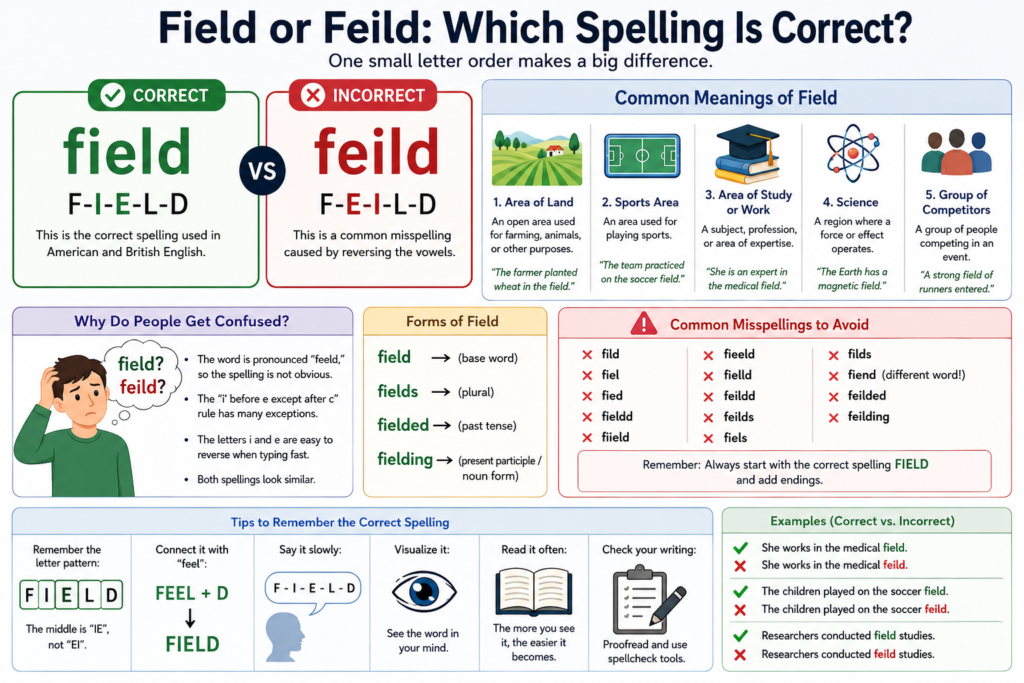
The good news is simple: field is the correct spelling in standard English, while feild is an incorrect spelling. The correct form is used in American English, British English, Canadian English, Australian English, and other standard varieties of English.
The confusion becomes even greater when people encounter related typing errors such as fild, fiel, fied, fieldd, fiield, fieeld, fielld, feildd, feilds, fiels, filds, fiend, feilded, and feilding. Most of these are simple spelling or typing mistakes rather than accepted alternatives.
This guide explains the difference between field and feild in simple language. It covers the meaning of field, pronunciation, grammar, common uses, examples, spelling patterns, reasons for the confusion, related misspellings, and practical ways to remember the correct form.
Field or Feild: The Quick Answer
The correct spelling is:
Field
The incorrect spelling is:
Feild
For example:
- She works in the medical field.
- The children played on the soccer field.
- Scientists studied the field of environmental science.
These sentences should not use “feild.”
Incorrect:
- She works in the medical feild.
Correct:
- She works in the medical field.
There is no American-versus-British spelling difference here. Both major varieties use field. The spelling does not change depending on whether the writer is in the United States or the United Kingdom.
Cambridge Dictionary gives the pronunciation of field as /fiːld/ and lists several meanings, including an area of land, an area of force, a sports area, a group of competitors, and an area of activity or interest.
How Do You Spell Field?
The correct spelling is:
F-I-E-L-D
A useful way to remember it is to divide the word visually:
F + I + E + L + D
The important part is the middle:
IE
Not:
EI
Therefore:
- field = correct
- feild = incorrect
This small difference explains most searches for “field or feild.”
The word field has been part of English for many centuries. Modern dictionaries trace it back to Old English feld, while the modern “ie” spelling developed through the history of English. Merriam-Webster dates the noun field to before the 12th century.
What Does Field Mean?
The word field has several meanings. Its original and most familiar meaning relates to an area of open land.
A field can be a piece of land used for growing crops, keeping animals, or other outdoor activities.
For example:
- The farmer planted wheat in the field.
- The cows were standing in the field.
- We walked across a large field.
- The children ran through the grassy field.
But field is not limited to agriculture. It has developed many broader meanings and is now one of the most useful words in English.
It can describe an area of study, work, research, business, science, technology, sports, or professional activity.
For example:
- She works in the field of medicine.
- Computer science is a growing field.
- He has experience in the financial field.
- Researchers are making progress in the field of artificial intelligence.
The word can also refer to a physical area where a particular force operates, such as a magnetic field or gravitational field.
Cambridge Dictionary includes land, practical work, areas of force, sports, competitors, and areas of interest among the major meanings of field.
Also Read: Bvostfus Python: Complete Guide to Meaning, Installation, Issues, Updates, Safety, and Practical Use
How Do You Pronounce Field?
Field is pronounced like “feeld.”
The standard pronunciation is represented as /fiːld/. Both US and UK pronunciations use the same basic sound.
The word contains a long “ee” sound, similar to the vowel sound in words such as “feel.”
Compare:
- feel
- field
- wheel
- shield
This pronunciation can sometimes make the spelling more confusing because the sound does not clearly tell you whether the middle letters should be “ie” or “ei.”
That is one reason a person might write “feild” after hearing the word rather than seeing it written.
Why Do People Confuse Field and Feild?
The main reason people confuse field and feild is letter order.
When spoken, the two spellings sound the same. A person who knows the word well may still type the letters in the wrong order because “ie” and “ei” are common sources of spelling mistakes in English.
Another reason is the familiar spelling rule:
“I before E except after C.”
This rule is taught to many English learners, but it has many exceptions and cannot reliably determine the spelling of every word.
The word field follows the “ie” order:
F-I-E-L-D
Because people remember different spelling patterns, they may hesitate and reverse the vowels:
F-E-I-L-D
That creates feild.
The problem becomes more common during fast typing. Since field is a very familiar word, the writer may type it automatically and fail to notice that the vowels were reversed.
Field and Feild: Is Feild Ever Correct?
In standard modern English, feild is not the correct spelling of the common word field.
If you intend to refer to land, a profession, an academic subject, a sports area, or a scientific concept, use field.
For example:
Correct:
- He studied the field of biology.
- The baseball field was empty.
- The farmer inspected the field.
- The magnetic field is invisible.
Incorrect:
- He studied the feild of biology.
- The baseball feild was empty.
- The farmer inspected the feild.
- The magnetic feild is invisible.
The spelling feild may appear in user-generated text, search queries, names, historical material, or other unusual contexts, but that does not make it the standard spelling of the English word.
Field in American English
For a US audience, field is always the spelling you should use.
American English uses field in everyday conversation, education, business, science, sports, technology, medicine, and many other areas.
Examples include:
- field of study
- field research
- field work
- football field
- baseball field
- field office
- field engineer
- field test
- magnetic field
- field experience
There is no special American spelling such as feild.
This is important for students, job applicants, business writers, researchers, and professionals. A misspelling such as feild can make otherwise strong writing appear careless.
Field in British English
British English also uses field.
For example:
- The farmer walked across the field.
- She is an expert in her field.
- The football team trained on the field.
- Researchers conducted field studies.
Therefore, field is not one of those words where American and British English have different spellings.
The same form works across both varieties.
The Difference Between Field and Feild
The difference can be summarized very simply.
| Spelling | Status | Meaning |
| field | Correct | A standard English word with many meanings |
| feild | Incorrect | A common misspelling of field |
The most important detail is letter order.
Field:
F-I-E-L-D
Feild:
F-E-I-L-D
The second version moves the “i” and “e” into the wrong order.
Common Meanings of Field
Because field is such a versatile word, understanding its meanings makes it easier to use correctly.
Field as an Area of Land
The most traditional meaning is an open area of land.
For example:
- The farmer owns three fields.
- The horses are grazing in the field.
- We crossed a field on our way home.
- The field was covered with wildflowers.
A field can contain crops, grass, animals, or other vegetation.
Field as a Sports Area
Field can describe an area used for sports.
Examples include:
- soccer field
- football field
- baseball field
- cricket field
- playing field
Example:
“The team practiced on the field before the game.”
In American English, “football field” usually refers to the rectangular playing surface used for American football.
Field as an Academic Subject
Field can mean a particular branch of knowledge or study.
Examples:
- the field of biology
- the field of economics
- the field of engineering
- the field of psychology
- the field of history
- the field of computer science
Example:
“Artificial intelligence is an important field of computer science.”
This use is especially common in education and professional writing.
Field as a Profession or Industry
People also use field to describe a professional area.
For example:
“She has worked in the healthcare field for ten years.”
Other examples include:
- technology field
- medical field
- legal field
- education field
- financial field
- engineering field
- marketing field
This meaning is close to words such as profession, discipline, industry, or area of expertise, although the exact meaning depends on context.
Field in Science
In science, field can describe an area where a force or effect exists.
Common examples include:
- magnetic field
- electric field
- gravitational field
For example:
“The Earth has a magnetic field.”
In this context, field does not mean a grassy area. It describes a scientific concept.
Field as Practical Work
The phrase “in the field” often refers to practical work conducted outside an office, classroom, or laboratory.
For example:
“The researchers spent six months in the field.”
A field researcher may collect information directly from the real-world environment rather than relying only on laboratory or desk-based work.
Field as a Group of Competitors
In sports and competitions, field can also describe the competitors taking part.
For example:
“A field of 100 runners entered the race.”
Here, field means the group of participants.
Field as a Noun
Field is most commonly used as a noun.
A noun names a person, place, thing, concept, or idea.
Examples:
- The field is wet.
- The field contains several crops.
- She entered the field of medicine.
- The magnetic field is strong.
- The players ran onto the field.
The meaning changes according to context, but the spelling remains field.
Field as a Verb
Field can also be used as a verb.
As a verb, it can mean to respond to questions, requests, or situations.
For example:
“The manager had to field several difficult questions.”
It can also be used in sports, particularly when discussing catching or stopping a ball.
For example:
“The shortstop fielded the ball quickly.”
Another use is to field a team or group of players.
For example:
“The university fields teams in several sports.”
These meanings are recognized in standard English dictionaries.
Field as an Adjective
Field can also appear as an adjective in compounds.
Examples include:
- field research
- field work
- field test
- field office
- field study
- field engineer
- field report
For example:
“The company conducted a field test before launching the product.”
Here, field helps describe something connected with practical, real-world activity.
Common Expressions With Field
The word field appears in many common English expressions.
In the Field
“In the field” can mean working in a real-world environment or operating within a professional area.
Example:
“The engineers are currently working in the field.”
Field of Study
This refers to an academic subject or discipline.
Example:
“Computer science is his field of study.”
Field of Work
This refers to someone’s professional area.
Example:
“What field of work are you interested in?”
Field Experience
This describes practical experience gained outside a classroom or theoretical setting.
Example:
“The position requires two years of field experience.”
Field Research
This refers to research performed in a real-world environment.
Example:
“The scientists conducted field research in several locations.”
Level the Field
To “level the playing field” means to make a situation fairer by reducing an advantage held by one side.
Example:
“The new policy could help level the playing field for smaller companies.”
Common Spelling Mistakes Related to Field
Field is frequently mistyped in several ways. Some errors are caused by reversing letters, while others happen because of repeated letters or missing letters.
Common examples include:
- fild
- fiel
- fied
- fieldd
- fiield
- fieeld
- fielld
- feildd
- feilds
- fiels
- filds
- fiend
- feilded
- feilding
These forms do not all represent the same kind of error.
Some are obvious keyboard mistakes. Others are attempts to form plural, past-tense, or continuous forms from the incorrectly spelled base word.
The correct forms should always be based on field.
For example:
- field → correct
- fields → correct plural
- fielded → correct past form
- fielding → correct continuous or noun form
Not:
- feilds
- feilded
- feilding
Fild vs Field
Fild is usually a shortened or incorrectly spelled version of field.
The correct spelling is field.
Incorrect:
“The scientist worked in the fild.”
Correct:
“The scientist worked in the field.”
The missing “e” changes the spelling, even though readers may understand the intended meaning.
Fiel vs Field
Fiel is another incomplete spelling.
The correct form is field.
This error can happen when someone types too quickly and leaves out the final letters.
Incorrect:
“The soccer fiel was crowded.”
Correct:
“The soccer field was crowded.”
Fied vs Field
Fied may result from rearranging or omitting letters.
It is not the standard spelling of the word.
Correct:
“The researcher entered the field.”
Incorrect:
“The researcher entered the fied.”
Fieldd vs Field
Fieldd contains an extra “d.”
The correct word ends with a single d:
F-I-E-L-D
Not:
F-I-E-L-D-D
This type of mistake is especially common when typing quickly or accidentally holding down a key.
Fiield vs Field
Fiield contains an extra “i.”
The correct spelling does not have two i’s.
Correct:
field
Incorrect:
fiield
A useful visual memory aid is to remember the middle sequence as “ie” followed by “ld.”
Fieeld vs Field
Fieeld contains an unnecessary extra “e.”
Correct:
field
Incorrect:
fieeld
The standard spelling has only one i and one e before the letters l and d.
Fielld vs Field
Fielld adds an extra “l.”
Correct:
field
Incorrect:
fielld
Remember the ending:
-L-D
There is only one l.
Feildd vs Field
Feildd combines two common mistakes: the vowels are reversed and an extra d is added.
The correct spelling remains:
field
If you are unsure, write the word slowly as:
F-I-E-L-D
Feilds vs Fields
Feilds is the incorrect version of the plural form.
The correct plural is:
fields
For example:
Correct:
“The farmer owns several fields.”
Incorrect:
“The farmer owns several feilds.”
The plural simply adds s to the correctly spelled singular noun.
Field → fields
Fiels vs Fields
Fiels is another common typo. It leaves out the letter d.
Correct:
fields
Incorrect:
fiels
For the plural, remember that field already ends in d before the plural s.
Filds vs Fields
Filds combines two errors: the e is missing, and the word is then made plural.
Correct:
fields
Incorrect:
filds
The correct sequence is:
F-I-E-L-D-S
Fiend vs Field
Fiend is particularly interesting because it is an actual English word, but it has a completely different meaning.
A fiend can refer to an evil or cruel person, or someone who is extremely enthusiastic about something in an informal expression.
For example:
- “The villain was described as a fiend.”
- “She is a coffee fiend.”
This means that fiend should not automatically be treated as a misspelling of field. It is a real word with different pronunciation and meaning.
Field refers to land, an area of activity, a scientific concept, a sports area, and other related ideas.
Fiend has a different meaning altogether.
Feilded vs Fielded
Feilded is an incorrect spelling of fielded.
The correct form is fielded.
For example:
Correct:
“The player fielded the ball successfully.”
Incorrect:
“The player feilded the ball successfully.”
The past-tense form is created from the correct base word:
field + ed = fielded
There is no need to change the order of the vowels.
Feilding vs Fielding
Feilding is an incorrect spelling of fielding.
The correct form is fielding.
For example:
“Fielding is an important skill in baseball.”
The word fielding can describe the act of playing defensively or handling a ball in certain sports. It can also appear in other contexts derived from the verb field.
The spelling is:
F-I-E-L-D-I-N-G
Not:
F-E-I-L-D-I-N-G
Why the “I Before E” Rule Does Not Solve Everything
One reason field creates confusion is the famous spelling guideline “i before e except after c.”
While this rule can sometimes help learners, English has many exceptions and complications. It should not be treated as a universal formula.
For field, the correct spelling happens to contain “ie”:
f-i-e-l-d
However, simply memorizing a broad spelling rule may not be enough. The most reliable approach is to learn common words individually and recognize their visual patterns.
This is especially useful for words that are frequently typed.
Instead of thinking about the entire spelling rule every time, memorize:
Field = F-I-E-L-D
Once that sequence becomes familiar, you are less likely to reverse the vowels.
A Simple Memory Trick for Field
One easy memory trick is to connect field with the word “feel.”
The words look similar:
feel
field
Both begin with:
F-I-E
Then field adds:
L-D
So you can remember:
FEEL + D = FIELD
This is not a formal spelling rule, but it is a useful memory device.
Another method is to say the letters while writing:
F-I-E-L-D
After repeating this several times, the correct order becomes more automatic.
Field in School and Academic Writing
Students often need the word field when writing about academic subjects.
Examples include:
- field of science
- field of mathematics
- field of history
- field of medicine
- field of engineering
- field of education
- field of psychology
For example:
“Biology is a broad field that includes many specialized areas.”
Because academic writing is often graded for spelling, using field rather than feild is important.
A spelling mistake does not necessarily change the meaning, but it can reduce the professionalism and clarity of the writing.
Field in Professional Writing
Field is also common in resumes, cover letters, reports, business documents, and workplace communication.
Examples:
“I have five years of experience in the technology field.”
“She is an experienced professional in the healthcare field.”
“The company has expanded into a new field.”
“The engineers gathered field data before preparing the report.”
In professional communication, correct spelling matters because small errors can affect how polished a document appears.
Field in Technology
Technology provides another common use of field.
In software, databases, forms, and digital systems, a field can refer to a specific place where information is entered or stored.
For example, a form may contain fields for:
- Name
- Address
- Phone number
- ZIP code
A database may also contain different fields for customer information.
This meaning comes from the broader idea of a field as a defined area or space.
Also Read: Google Fan: What It Means, Google Zipper, Easter Eggs, Games, and the Fun Side of Google
For example:
“Please enter your name in the required field.”
The spelling is still field, not feild.
Field in Science and Research
Scientists use the word field in several ways.
A researcher may work in the field rather than inside a laboratory.
A physicist may study a magnetic field.
A researcher may specialize in a particular scientific field.
These uses show why context matters.
Consider these sentences:
“The researcher returned to the field.”
“The researcher studies the field of ecology.”
“The magnet produces a magnetic field.”
The same word appears in each sentence, but the meaning changes.
Field in Sports
Sports are another major area where field appears.
Examples include:
- football field
- soccer field
- baseball field
- field hockey
- field player
- field goal
- fielding
The exact meaning depends on the sport.
In baseball, for example, fielding refers to defensive play involving catching or handling the ball.
In many other sports, a field is the physical playing area.
Using feild in sports writing is incorrect.
Field vs. Feild in Search Queries
People may search phrases such as:
- field or feild
- is it field or feild
- field spelling
- how to spell field
- fild or field
- feild meaning
- correct spelling of field
These searches usually indicate spelling uncertainty rather than a genuine alternative spelling.
Search users may also type longer variants such as “fild,” “fiel,” “fied,” “fieldd,” “fiield,” “fieeld,” or “fielld” while trying to determine which form is correct.
The answer remains the same: field is the standard spelling.
Why Misspellings Appear So Often Online
Digital communication creates many opportunities for spelling errors.
People type quickly on phones and computers. Autocorrect may not always catch every mistake. Search boxes can also contain incomplete or misspelled words.
Because field is short, common, and contains an unusual vowel sequence, it is especially easy to mistype.
Common causes include:
- Reversing i and e
- Leaving out a letter
- Adding an extra letter
- Typing too quickly
- Relying on pronunciation
- Applying a spelling rule incorrectly
- Forgetting the visual form of the word
The solution is usually simple: slow down and check the middle of the word.
Common Examples of Field
Here are examples showing the most common uses.
Land
“The farmer walked across the field.”
Agriculture
“The workers planted corn in the field.”
Sports
“The players ran onto the football field.”
Education
“She chose biology as her field of study.”
Profession
“He has worked in the technology field for years.”
Science
“The Earth has a magnetic field.”
Research
“The team conducted field research.”
Practical Work
“Engineers gathered data in the field.”
Competition
“A strong field of runners entered the race.”
Questions
“The manager had to field several difficult questions.”
These examples demonstrate why field is such a flexible word.
Common Sentences: Correct and Incorrect
Seeing the difference in complete sentences can make the spelling easier to remember.
Incorrect:
“She is an expert in her feild.”
Correct:
“She is an expert in her field.”
Incorrect:
“The players entered the feild.”
Correct:
“The players entered the field.”
Incorrect:
“Scientists studied the magnetic feild.”
Correct:
“Scientists studied the magnetic field.”
Incorrect:
“The farmer owns several feilds.”
Correct:
“The farmer owns several fields.”
Incorrect:
“He has years of feild experience.”
Correct:
“He has years of field experience.”
Incorrect:
“The player feilded the ball.”
Correct:
“The player fielded the ball.”
Incorrect:
“The team practiced feilding.”
Correct:
“The team practiced fielding.”
Field or Feild: A Simple Comparison
The following comparison makes the answer easy to remember:
| Feature | Field | Feild |
| Standard English spelling | Yes | No |
| Used in US English | Yes | No |
| Used in British English | Yes | No |
| Refers to land | Yes | No |
| Refers to a profession | Yes | No |
| Used in science | Yes | No |
| Used in sports | Yes | No |
| Used as a verb | Yes | No |
| Standard dictionary word | Yes | No |
| Common spelling mistake | No | Yes |
The key difference is the order of the middle vowels.
How to Avoid Spelling Field Incorrectly
A few simple habits can help.
Memorize the Letter Pattern
Remember:
F-I-E-L-D
Do not rely only on pronunciation.
Connect It With Feel
Think:
feel + d = field
This can help reinforce the “ie” sequence.
Read the Word Regularly
Frequent exposure to correctly spelled words improves visual memory.
Use Spellcheck
Spellcheck tools can identify many common typing mistakes, including reversed letters.
Proofread Important Writing
If you are writing a resume, report, school assignment, application, or professional email, take a moment to check common words.
Watch for the Middle Letters
The biggest danger is usually:
ie → correct
ei → incorrect
When you see “feild,” check the vowels first.
Is Field a Common Word?
Yes. Field is an extremely common English word because it applies to many everyday and specialized situations.
People encounter it in:
- farming
- sports
- education
- science
- technology
- business
- medicine
- research
- engineering
- geography
- entertainment
- everyday conversation
Its many meanings make it useful across different areas of life.
The historical development of the word also helps explain its broad range. Etymological sources trace field to Old English feld, originally associated with open land, pasture, or cultivated land. Over time, meanings connected to battlefields, areas of activity, science, sports, and other concepts developed.
The History Behind the Spelling
The spelling of field may look unusual, but it has a long history.
The word comes from Old English feld. Related forms appeared in other Germanic languages as well. Historical sources also explain that the modern English “ie” spelling was influenced by the development of English writing and Anglo-French scribal practices.
This history is useful because it shows that field is not a modern spelling invention. Its spelling developed over centuries.
The incorrect form feild is best understood as a modern spelling error caused by letter-order confusion rather than as a standard historical variant in contemporary English.
Is “Feild” a Different Word?
In ordinary modern English, feild should not be treated as a different standard word.
If you want to describe an open area of land, an academic discipline, a professional area, a sports surface, or a scientific region of influence, the correct word is field.
The presence of feild in a search query does not change the standard spelling.
This distinction is important for writers who may encounter the misspelling online and wonder whether it is an alternative form.
Why Pronunciation Cannot Tell You the Spelling
Field and feild are problematic because reversing the letters does not create an obvious pronunciation difference.
Both may be read as “feeld” by a reader who understands the intended word.
This means listening alone cannot tell you which spelling is correct.
The same problem appears with many English words where several letter combinations can represent similar sounds.
That is why visual memory, reading experience, and dictionary confirmation are useful for spelling.
Field in Different Forms
Knowing the related forms of field can help prevent mistakes.
Singular
field
Example:
“The field is large.”
Plural
fields
Example:
“The fields are green.”
Past Tense
fielded
Example:
“The player fielded the ball.”
Present Participle
fielding
Example:
“The team is fielding a strong lineup.”
Notice that the spelling remains based on field in every form.
Incorrect:
feild
feilds
feilded
feilding
Correct:
field
fields
fielded
fielding
A Useful Spelling Pattern
One way to see the word is:
FI + ELD
Or simply:
F-I-E-L-D
The letters “ie” appear together.
Once you learn the word as a complete visual unit, you do not need to reconstruct its spelling every time.
This is often more effective than trying to apply complicated spelling rules.
What Should You Write in Formal English?
In formal English, always choose field.
Also Read: Quad Equalizer: The Meaning, Audio Uses, Types, Features, and Related “Quad” Terms
For example:
- field of research
- field of study
- field experience
- field investigation
- field report
- field work
- field test
- field office
- field engineer
Avoid forms such as:
- feild of research
- feild of study
- feild experience
- feild investigation
- feild report
- feild work
- feild test
- feild office
- feild engineer
The correct spelling improves clarity and gives your writing a more polished appearance.
Field or Feild: Final Verdict
The answer is straightforward.
Field is correct.
Feild is incorrect.
The standard spelling is F-I-E-L-D, with “i” before “e.” The word is pronounced “feeld” and can refer to an area of land, a sports surface, an academic or professional area, a scientific concept, practical work, a group of competitors, or several other related ideas.
The confusion happens mainly because the pronunciation does not reveal the letter order, the “ie” sequence can be easy to reverse, and the familiar “i before e” rule can create uncertainty.
Related mistakes such as fild, fiel, fied, fieldd, fiield, fieeld, fielld, feildd, feilds, fiels, filds, feilded, and feilding should not be used when you mean the standard English word.
Remember the simple pattern:
Field = F-I-E-L-D
A useful memory trick is to connect field with feel:
FEEL + D = FIELD
Once you remember that sequence, the spelling becomes much easier.
FAQs About Field or Feild
1. Is “feild” ever accepted in standard American English?
No. When you mean the common English word referring to land, a subject of study, a profession, a sports area, or another standard meaning, field is the correct spelling. Feild is generally a spelling mistake.
2. Why does “field” have an unusual “ie” spelling?
The spelling developed through the history of English. The modern form ultimately comes from Old English feld, and historical sources note that the development of the “ie” spelling was influenced by Anglo-French scribal conventions.
3. Does the plural of field become “feilds”?
No. The correct plural is fields.
The spelling changes only by adding s:
field → fields
Therefore, “feilds” is incorrect when it is intended as the plural of field.
4. Is “fiend” another spelling of field?
No. Fiend is a separate English word with its own meaning and pronunciation. It can refer to an evil or cruel person and can also be used informally for someone who is extremely enthusiastic about something. It should not be used as a spelling of field.
5. What is the easiest way to remember how to spell field?
Remember the sequence F-I-E-L-D. You can also connect it with “feel” and think “feel + d = field.” The key point is that the middle letters are “ie,” not “ei.”