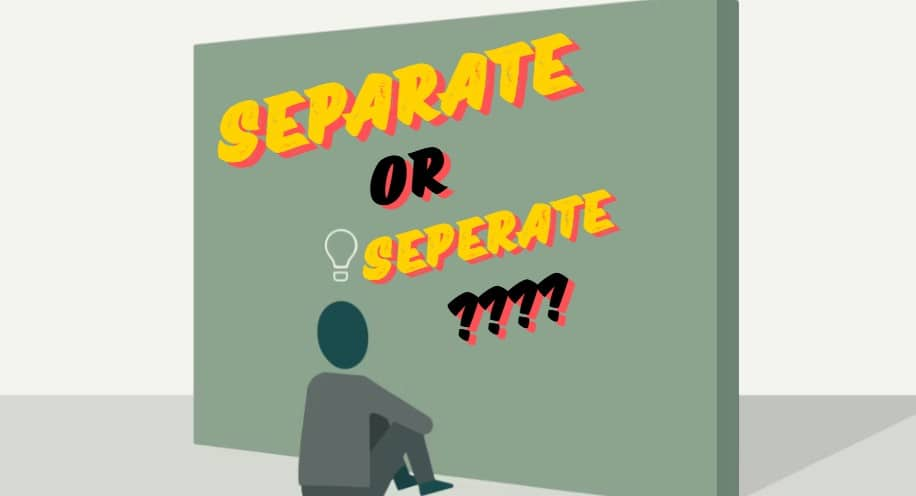
If you have ever stopped while writing an email, school assignment, business document, or social media post and wondered whether the correct spelling is “separate” or “seperate,” you are not alone. This is one of the most common English spelling questions.
The correct spelling is “separate.”
“Seperate” is a common misspelling of “separate.” It is not the standard spelling in modern American English. The confusion happens mainly because the word is pronounced in a way that can make the middle vowel sound unclear.
For example:
- Correct: Please keep the two files separate.
- Incorrect: Please keep the two files seperate.
- Correct: The teacher asked the students to separate into groups.
- Incorrect: The teacher asked the students to seperate into groups.
The word “separate” can work as a verb, adjective, and, in some contexts, a noun. Its meaning generally relates to things being apart, divided, distinct, or kept away from one another.
This guide explains the difference between “separate or seperate,” how to remember the correct spelling, how to use “separate” in a sentence, why the mistake happens, and how related misspellings such as “seprate,” “separat,” “seperat,” “seperete,” and “seperrate” can be avoided.
Separate or Seperate: The Short Answer
The correct spelling is “separate.”
The spelling “seperate” is incorrect in standard English.
A simple way to remember the difference is:
“Separate” contains “a” in the middle.
You can think of it as:
SEPARATE
Not:
SEPERATE
A useful memory trick is to connect “separate” with the word “par.” The letters “par” appear in “separate”:
sep + ar + ate
Another helpful idea is to remember the phrase:
“Separate has an A.”
This small spelling rule can help prevent one of the most frequent mistakes involving this word.
What Does Separate Mean?
“Separate” generally means to move things apart, keep things apart, or describe things that are not joined together.
As an adjective, it describes something that is distinct or apart.
Example:
“We have separate offices.”
This means the offices are not the same office or are not physically joined.
As a verb, “separate” means to divide or move apart.
Example:
“Please separate the white clothes from the dark clothes.”
Here, the action is dividing one group from another.
The word can also describe people, objects, ideas, groups, places, or categories.
For example:
- Separate rooms
- Separate accounts
- Separate payments
- Separate groups
- Separate opinions
- Separate documents
- Separate categories
- Separate responsibilities
The basic idea remains the same: something is being treated as distinct or apart.
Why Is “Seperate” Incorrect?
“Seperate” is incorrect because the standard English spelling uses “a,” not “e,” in the relevant middle position.
The correct form is:
“separate”
The incorrect form is:
“seperate”
This error is understandable because English spelling does not always match pronunciation. When people say “separate,” the middle vowel may not sound as clear as the written “a.” As a result, writers may naturally assume that an “e” belongs there.
This is especially common when someone has learned the word mainly through hearing it rather than seeing it written.
Also Read: Incfidelibus: Meaning, Origins, Trust, Loyalty, and Modern Use
The mistake can also become a habit. If someone repeatedly sees or types “seperate,” the incorrect version may begin to look normal.
That is why spelling memory is useful.
Separate vs. Seperate: A Simple Comparison
| Word | Correct? | Meaning |
| Separate | Yes | Apart, distinct, or to divide |
| Seperate | No | Common spelling mistake |
| Seprate | No | Misspelling caused by missing a vowel |
| Seperat | No | Incomplete or misspelled form |
| Seperete | No | Incorrect vowel pattern |
| Seperrate | No | Incorrect spelling with an extra “r” |
| Separatte | No | Incorrect spelling with an extra “t” |
When choosing between “separate or seperate,” always select “separate” in standard American English.
How to Remember the Spelling of Separate
The spelling can be difficult, but several memory tricks make it easier.
Remember: Separate Has an A
The easiest trick is:
“Separate has an A.”
When you are unsure, look at the middle of the word and remember the “a.”
Separate:
S E P A R A T E
Seperate:
S E P E R A T E
The second version changes the “a” to an “e.”
Use the Word “Par” as a Memory Aid
The letters “par” appear in “separate.”
You can mentally break the word into:
SEP + AR + ATE
The “par” idea is not a complete pronunciation guide, but it can help you remember that the word contains an “a” in the middle.
Think About Separation
The noun “separation” uses the same basic spelling pattern.
Compare:
- separate
- separation
- separating
- separated
Seeing these related forms can reinforce the correct spelling.
Write It Several Times
If you frequently make this mistake, write:
separate
separate
separate
separate
separate
Repeated exposure can help the correct spelling become automatic.
Separate and Separation: How Are They Related?
“Separation” is a noun connected to “separate.”
For example:
“The separation of the two groups happened gradually.”
The relationship is:
- separate — adjective or verb
- separated — past form or adjective
- separating — present participle
- separation — noun
These words share the same basic spelling pattern.
Learning a family of related words can be more effective than memorizing a single word in isolation.
How to Use Separate as an Adjective
As an adjective, “separate” describes something that is distinct, independent, or apart.
Examples include:
“We have separate bedrooms.”
“The company has separate departments for sales and support.”
“Please use separate containers for the ingredients.”
“They maintain separate bank accounts.”
“She has a separate office.”
In each example, “separate” tells the reader that the things being discussed are distinct from each other.
How to Use Separate as a Verb
As a verb, “separate” describes an action in which something is divided or moved apart.
Examples:
“Separate the documents by date.”
“The workers separated the materials into three groups.”
“Please separate the recyclable items from the trash.”
“The referee had to separate the players.”
The verb can describe physical separation as well as the division of information, ideas, groups, or categories.
How to Use Separated in a Sentence
“Separated” is the past tense or past participle of “separate.”
Examples:
“The two boxes were separated.”
“The students were separated into different classrooms.”
“The files were separated by category.”
“The ingredients should be separated before cooking.”
“Separated” can also describe a state in which people or things are apart.
How to Use Separately in a Sentence
“Separately” is an adverb formed from “separate.”
It usually means independently, individually, or apart from something else.
Examples:
“The items were packaged separately.”
“Please submit each form separately.”
“The charges will appear separately on the bill.”
“The two issues should be considered separately.”
A common spelling mistake is “seperately” or “seperatly.”
The correct spelling is:
separately
Not:
seperately
Not:
seperatly
Not:
seperatelyy
If you are searching for “separately” because you are unsure about its spelling, remember that it comes from “separate,” so it keeps the “a.”
Separate vs. Separately
These two words are closely related but perform different jobs.
“Separate” can describe something or express an action.
Example:
“We have separate accounts.”
“Separately” describes how an action happens.
Example:
“We paid for the items separately.”
A simple distinction is:
Separate = apart or divide.
Separately = in an individual or independent way.
Separate vs. Separation
“Separate” and “separation” have related meanings but different grammatical roles.
“Separate” can be an adjective or verb.
Example:
“The two teams have separate facilities.”
“Separation” is a noun.
Example:
“The separation of the teams was necessary.”
Understanding word families is helpful for spelling, grammar, and vocabulary development.
Common Misspellings of Separate
People search for many incorrect versions of “separate.” These mistakes often occur because of pronunciation, typing habits, or uncertainty about vowel placement.
Some common forms include:
- seprate
- separat
- seperat
- seperete
- seperrate
- seperated
- separete
- separete
- seperete
- separatte
- seperrate
- seperately
- seperatly
- seperatelyy
- seperation
- seperating
- seperater
- seperaterly
These forms should not be used in formal American English.
Seprate
“Seprate” is usually created when a writer accidentally leaves out a vowel.
Correct:
“separate”
Incorrect:
“seprate”
Separat
“Separat” is usually an incomplete spelling.
The correct word is “separate.”
Seperat
“Seperat” combines the common vowel mistake with an incomplete ending.
The correct spelling remains “separate.”
Seperete
“Seperete” contains multiple incorrect vowel choices.
The correct form is “separate.”
Seperrate
“Seperrate” contains both an incorrect vowel and an extra “r.”
The correct spelling has only one “r” in that position:
separate
Seperated
The correct word is “separated.”
Correct:
“The files were separated.”
Incorrect:
“The files were seperated.”
Separete
“Separete” uses the wrong final vowel pattern.
The correct form is “separate.”
Separatte
“Separatte” contains an extra “t.”
The correct spelling is “separate.”
Seperately
The correct spelling is “separately.”
The word begins with the same spelling pattern as “separate.”
Seperatly
The correct spelling is “separately,” not “seperatly.”
Seperatelyy
This version contains both an incorrect vowel pattern and an extra “y.”
The correct spelling is “separately.”
Seperation
The correct spelling is “separation.”
The spelling changes slightly when the noun is formed, but the “a” pattern remains important.
Seperating
The correct spelling is “separating.”
Seperater
Depending on the intended meaning, “separater” is usually not the standard word people want. “Separator” is commonly used for a device or thing that separates items.
For example:
“The separator divides the materials.”
Seperaterly
This is not a standard spelling. If the intended word is the adverb, use “separately.”
Why Do People Spell Separate as Seperate?
The main reason is pronunciation.
English has many words whose spelling cannot be predicted perfectly from their sound. “Separate” is one of them.
When spoken, the middle part may not receive strong emphasis. This can make the “a” less noticeable.
Another reason is visual familiarity.
If a person repeatedly reads the incorrect spelling “seperate,” the brain can begin to recognize it as familiar. Familiarity, however, does not make a spelling correct.
Typing also plays a role.
People often type quickly, especially on phones. Autocomplete, predictive text, and muscle memory can sometimes reinforce a spelling mistake.
The best response is not to feel embarrassed about the error. Instead, learn a reliable way to recognize the correct form.
Is Separate a Commonly Misspelled Word?
Yes. “Separate” is widely recognized as a word that people often misspell.
The mistake is common enough that many spelling resources, teachers, editors, and writing tools specifically highlight it.
This does not mean the word is unusually difficult. Rather, it demonstrates a larger fact about English: spelling is influenced by history, pronunciation, and language development, and not every spelling can be predicted from modern pronunciation.
Separate in American English
In American English, the standard spelling is:
separate
The same spelling is also standard in British English.
Therefore, unlike some American and British spelling differences such as “color” and “colour,” “separate” does not normally change based on whether you are writing for an American or British audience.
For a United States audience, use “separate.”
How to Pronounce Separate
“Separate” has different pronunciation patterns depending on whether it is used as an adjective or a verb.
As an adjective, it is commonly pronounced with the stress toward the first part of the word.
Example:
“They live in separate houses.”
As a verb, the pronunciation can place stronger emphasis on the first part as well, although the vowel sounds can differ somewhat in connected speech.
Because pronunciation can vary by context and accent, spelling should not be based only on how the word sounds.
When accuracy matters, the written form is the safest reference.
Examples of Separate in Everyday Writing
Here are simple examples:
“Please keep these documents separate.”
“We ordered separate meals.”
“The children sat at separate tables.”
“The company operates through separate departments.”
“The software keeps personal and business information separate.”
“Please create a separate account.”
“The two subjects should remain separate.”
“Each customer received a separate invoice.”
“The files are stored in separate folders.”
These examples show how widely the word can be used.
Separate in Business Writing
The word “separate” is especially common in professional communication.
Examples include:
“Please send the invoices as separate files.”
“The project has separate budgets for each department.”
“Customer data should be kept separate from internal records.”
“The company maintains separate accounts for each business unit.”
“Please create a separate report for each location.”
Using the correct spelling matters in professional writing because spelling errors can make otherwise clear communication look less polished.
Also Read: Field or Feild: Which Spelling Is Correct?
Separate in Academic Writing
Students also frequently use “separate.”
Examples:
“The study analyzed the two groups separately.”
“The results were presented in separate tables.”
“The researchers examined the variables separately.”
“The assignment requires separate sections for each topic.”
In academic writing, correct spelling supports clarity and credibility.
A single spelling mistake does not necessarily make an argument incorrect, but repeated errors can distract readers and reduce the professional appearance of a paper.
Separate in Digital Communication
The word appears frequently in emails, text messages, websites, online forms, software instructions, and digital documents.
For example:
“Create a separate password.”
“Save the files separately.”
“Use a separate browser window.”
“Keep work and personal accounts separate.”
Because people type quickly online, misspellings such as “seperate,” “seperately,” and “seperation” can appear frequently in informal searches.
Search engines and spelling tools may understand the intended word, but writers should still use the correct spelling in published content.
Does Google Understand “Seperate”?
Search engines are generally designed to understand common spelling mistakes and may interpret “seperate” as an attempt to search for “separate.”
However, search understanding does not make the misspelled form correct.
For SEO and professional writing, the correct spelling should be used.
If a page is specifically designed to answer the spelling question “separate or seperate,” it can naturally mention the incorrect spelling because that is part of the user’s search intent.
The goal should be to explain the difference clearly rather than repeatedly inserting a misspelling just to attract search traffic.
SEO Search Intent for “Separate or Seperate”
The search query “separate or seperate” has clear informational intent.
Most people using this query want to know:
- Which spelling is correct?
- Why is “seperate” wrong?
- How do you spell separate?
- How do you remember the spelling?
- What does separate mean?
- How do you use separate in a sentence?
- Is “seperately” correct?
- Is “separation” spelled with an “a”?
- Why is separate so easy to misspell?
A useful SEO page should answer these questions quickly and then provide deeper information.
This is more helpful than repeating the exact keyword many times.
How to Optimize Content About Separate or Seperate
Good SEO content should focus on user intent first.
For a spelling topic, a strong page should provide the answer near the beginning.
For example:
“The correct spelling is separate. Seperate is a common misspelling.”
That short answer is useful for readers and suitable for a featured snippet.
After the direct answer, the page can explain meaning, examples, pronunciation, memory techniques, related words, and common mistakes.
Semantic SEO is also important. A strong article naturally discusses related terms such as:
- spelling
- grammar
- vocabulary
- pronunciation
- English language
- American English
- misspelling
- correct spelling
- word meaning
- sentence examples
- writing
- editing
- proofreading
- word forms
- separation
- separately
- separated
- separating
These terms help establish the subject of the article without forcing keywords into every sentence.
Separate and Featured Snippets
A featured snippet often gives a short answer to a direct question.
For example:
Question: “Is it separate or seperate?”
Answer:
“The correct spelling is separate. Seperate is a common misspelling.”
This format is effective because it answers the question immediately.
Longer explanations can then provide examples and context.
For People Also Ask-style searches, useful questions include:
“Is it separate or seperate?”
“Why do people spell separate incorrectly?”
“How do you remember the spelling of separate?”
“What is the meaning of separate?”
“Is seperately a word?”
“What is the correct spelling of separation?”
These questions reflect common user needs.
Common Sentences Using Separate
Here are additional examples:
“Keep the receipts in a separate folder.”
“The two departments work separately.”
“The teacher placed the students into separate groups.”
“The company has a separate customer service team.”
“We need separate documents for each application.”
“Please separate the old files from the new ones.”
“The subjects should be discussed separately.”
“The software creates a separate record for each user.”
“Each payment appears as a separate transaction.”
“The rooms have separate entrances.”
These examples show how flexible the word is.
Separate vs. Distinct
“Separate” and “distinct” can sometimes have similar meanings, but they are not always interchangeable.
“Separate” often emphasizes being apart or divided.
Example:
“The two offices are separate.”
“Distinct” often emphasizes being clearly different.
Example:
“The two products have distinct features.”
Something can be distinct without being physically separated.
Understanding this difference can improve vocabulary and writing precision.
Separate vs. Divide
“Separate” and “divide” are also closely related.
To divide something usually means to split it into parts.
To separate something means to move it apart or treat it as distinct.
For example:
“The teacher divided the class into four groups.”
“The teacher separated the students according to their skill levels.”
The exact choice depends on the intended meaning.
Separate vs. Apart
“Separate” can also be related to “apart.”
For example:
“The two buildings are separate.”
“The two buildings are far apart.”
“Separate” can describe a condition or arrangement, while “apart” often describes physical distance or separation.
The History Behind the Word Separate
“Separate” comes through the history of English from Latin roots associated with setting apart or making distinct. Its spelling reflects that history rather than simply representing modern pronunciation.
This is one reason English learners should not always expect a word’s spelling to be obvious from its sound.
Many English words have spellings influenced by Latin, French, Greek, Old English, and other languages.
“Separate” is therefore a useful example of how English spelling preserves historical patterns.
Why Correct Spelling Matters
Correct spelling helps readers understand information quickly.
In casual texting, a person may understand “seperate” without difficulty. However, in professional writing, schoolwork, websites, resumes, reports, and official communication, spelling accuracy is more important.
Correct spelling can improve:
- Readability
- Professional appearance
- Reader confidence
- Search visibility
- Communication quality
- Academic presentation
- Workplace communication
Spelling is only one part of good writing, but it is an important part.
How Spellcheck Can Help With Separate
Modern word processors and browsers often recognize “seperate” as a misspelling.
Depending on the software, the incorrect word may receive a red underline or another spelling warning.
However, spellcheck should not be your only method of proofreading.
Automated tools can miss context-based errors. They may also fail to understand what you intended to say.
A useful editing process combines spellcheck with careful reading.
How to Proofread for Separate
When reviewing your writing, search for the word “seperate.”
If you find it, replace it with “separate.”
You can also search for common related mistakes such as:
- seperately
- seperation
- seperated
- seperating
Then check whether the intended forms are:
- separately
- separation
- separated
- separating
This is an easy proofreading technique for documents containing many pages.
A Quick Memory Test
Ask yourself:
Which spelling looks correct?
A. Seperate
B. Separate
The answer is:
B. Separate
Now remember:
“Separate has an A.”
This simple phrase can help you make the correct choice quickly.
Tips for English Learners
English learners can find “separate” difficult because spelling and pronunciation do not perfectly match.
Here are some useful strategies.
First, learn the word visually.
Look at “separate” as a complete spelling pattern rather than trying to build it entirely from sound.
Second, learn related words.
Study:
- separate
- separated
- separating
- separately
- separation
Third, use the word in sentences.
For example:
“I keep my work and personal files separate.”
Fourth, use a dictionary or trusted spelling reference when uncertain.
Finally, read regularly. Frequent exposure to correctly spelled English words helps build visual word recognition.
Separate or Seperate in Formal Writing
For formal writing, always use “separate.”
This includes:
- Business letters
- Reports
- School essays
- College papers
- Resumes
- Cover letters
- Websites
- Professional emails
- Government documents
- Technical documentation
“Seperate” should not be used as the standard spelling.
Separate or Seperate on a Resume
A resume should use “separate,” not “seperate.”
For example:
Correct:
“Managed separate accounts for multiple clients.”
Incorrect:
“Managed seperate accounts for multiple clients.”
A resume often creates a first impression, so proofreading is especially important.
Separate or Seperate in Email
In an email, use “separate.”
Correct:
“Please send the two reports as separate attachments.”
Incorrect:
“Please send the two reports as seperate attachments.”
Even when an email is informal, using the correct spelling is a simple way to make communication clearer and more professional.
Separate or Seperate in School Work
Students should use “separate” in assignments.
Correct:
“The experiment included two separate groups.”
Incorrect:
“The experiment included two seperate groups.”
Teachers often understand what a student means despite spelling mistakes, but learning the correct form improves writing skills over time.
Does “Seperate” Ever Become Correct?
No. In standard modern English, “seperate” is not the accepted spelling of the word meaning apart or divide.
It may appear in user-generated content, informal messages, search queries, historical texts, or other places where spelling errors occur.
Its appearance in a document does not make it a standard spelling.
For normal American English writing, use “separate.”
Why “Separate” Is Easy to Forget
One reason is that the word contains several vowels.
S E P A R A T E
The combination of sounds can make the spelling harder to predict.
Another reason is that people may remember the pronunciation but not the visual structure.
The solution is to create a strong visual association.
Think:
SEPARATE = A
Then connect it with:
SEPARATION = A
SEPARATELY = A
This gives you a small spelling system rather than a single isolated memory.
What Is the Correct Spelling of Separating?
The correct spelling is “separating.”
Example:
“The machine is separating the materials.”
Not:
“seperating”
The word comes from “separate,” with the ending “-ing.”
What Is the Correct Spelling of Separated?
The correct spelling is “separated.”
Example:
“The documents were separated by category.”
Not:
“seperated”
The spelling keeps the “a” pattern from “separate.”
What Is the Correct Spelling of Separation?
The correct spelling is “separation.”
Example:
“The separation of the materials took several minutes.”
Not:
“seperation”
This is another important word in the same family.
What Is the Correct Spelling of Separately?
The correct spelling is “separately.”
Example:
“The products are sold separately.”
Not:
“seperately”
Not:
“seperatly”
Not:
“seperatelyy”
The correct form is:
separately
A Simple Word Family for Separate
Learning these forms together can make spelling easier:
Separate
Separated
Separating
Separately
Separation
You can think of them as one word family.
This is particularly helpful for students, English learners, writers, editors, and anyone who frequently encounters spelling questions.
Digital Literacy and Spelling Searches
People often type misspelled words into search engines because they are trying to discover the correct spelling.
There is nothing unusual about searching for “seperate,” “seprate,” or “seperately.”
However, users should be careful when clicking unfamiliar websites that promise instant answers, especially if a spelling query redirects to unrelated downloads, advertisements, or requests for personal information.
For a basic spelling question, there is usually no reason to provide sensitive personal information.
A good digital literacy habit is to check whether a source is trustworthy before relying on its advice.
How Writers Can Avoid Repeating the Mistake
Writers who frequently type “seperate” can create a personal correction habit.
For example:
- Write the sentence normally.
- Search the document for “seperate.”
- Replace it with “separate.”
- Search for “seperately.”
- Replace it with “separately.”
- Search for “seperation.”
- Replace it with “separation.”
- Run a final spelling check.
This method is especially useful for long documents.
Why Learning the Correct Form Is Better Than Memorizing the Error
It is tempting to remember “seperate” because that is the form many people see when searching for the answer.
Also Read: Bvostfus Python: Complete Guide to Meaning, Installation, Issues, Updates, Safety, and Practical Use
A better approach is to focus on the correct form.
Instead of thinking:
“Is it not seperate?”
Think:
“The correct word is separate.”
This shifts attention toward the right spelling rather than reinforcing the wrong one.
Quick Reference: Separate or Seperate
Correct spelling:
“separate”
Incorrect spelling:
“seperate”
Meaning:
Apart, distinct, or to divide.
Example:
“Please keep the files separate.”
Memory trick:
“Separate has an A.”
Related correct words:
- separated
- separating
- separately
- separation
Common incorrect forms:
- seprate
- separat
- seperat
- seperete
- seperrate
- seperated
- separete
- separatte
- seperately
- seperatly
- seperatelyy
- seperation
- seperating
- seperaterly
Frequently Asked Questions About Separate or Seperate
1. Can “separate” and “apart” always be used in the same sentence?
No. Although the two words can express a similar idea, they do not always work in exactly the same grammatical position. “Separate” can be an adjective or a verb, while “apart” commonly works as an adverb or adjective in particular constructions. The best choice depends on the sentence and the meaning you want to communicate.
2. Is “separate” pronounced differently when it is a verb and an adjective?
Yes, pronunciation can vary depending on how the word is used. The vowel sounds may also be reduced in natural speech. This variation is one reason it can be difficult to determine the spelling from pronunciation alone. When spelling is uncertain, remember the written form: “separate.”
3. Can “separate” describe ideas instead of physical objects?
Yes. “Separate” can describe abstract ideas, subjects, responsibilities, categories, issues, or concepts. For example, two issues can be treated as separate matters even when they have no physical form.
4. Is “separate” related to the word “separator”?
Yes. “Separator” is a noun that refers to a person, device, object, or component that separates things. It belongs to the same broader word family. For example, a separator in a system may divide materials or information into different categories.
5. Does the spelling of “separate” change in American English?
No. “Separate” is the standard spelling in American English, and it is also the standard spelling in British English. It is not one of the common words that changes spelling between these varieties of English.
Conclusion: Separate or Seperate
When deciding between “separate or seperate,” the answer is simple: “separate” is the correct spelling.
“Seperate” is a common misspelling, usually caused by the way the word sounds when spoken. Because the middle vowel can be difficult to hear clearly, writers may replace the “a” with an “e.”
The easiest memory trick is:
“Separate has an A.”
The same spelling pattern can help with related words such as “separated,” “separating,” “separately,” and “separation.”
For professional, academic, website, and everyday writing in the United States, use “separate.”